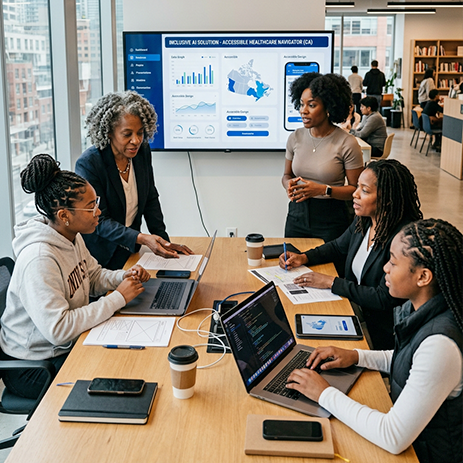

Artificial Intelligence
Empowering Black women to participate, lead, and innovate in Canada’s growing artificial intelligence economy.
Challenge Overview
Expanding Access to AI Leadership
Artificial Intelligence is transforming how societies operate, businesses compete, governments deliver services, and people interact with technology. From healthcare and education to finance, transportation, cybersecurity, climate solutions, and entrepreneurship, AI is shaping the future of the global economy.
Canada has established itself as a global leader in AI research and innovation, supported by strong academic institutions, technology companies, and a growing AI ecosystem. As AI expands, it creates opportunities for economic growth, job creation, entrepreneurship, and social innovation.
However, the benefits and influence of AI are not distributed equally. Black women remain underrepresented in AI education, research, development, entrepreneurship, leadership, and policy discussions. This creates a challenge because technologies shaping the future should reflect the communities they serve.
The challenge is not that Black women lack the ability to understand, create, or lead in AI. Many face barriers that limit access to AI knowledge, opportunities, resources, and decision-making spaces.

Key barriers include:
Limited access to AI education and training opportunities.
Underrepresentation in technology and AI careers.
Lack of visibility of Black women AI professionals and researchers.
Limited access to AI innovation networks.
Digital skills gaps created by unequal technology access.
Bias in AI systems that do not adequately reflect diverse experiences.
Limited participation in AI entrepreneurship and investment ecosystems.
Lack of representation in AI governance and policy development.
As AI systems increasingly influence decisions related to employment, healthcare, finance, education, security, and public services, diverse participation in AI development becomes essential. Without inclusive participation, AI technologies may reinforce existing inequalities by embedding historical biases into automated systems.
CBEE Women believes Black women must not only be users of artificial intelligence. They must be creators, researchers, entrepreneurs, leaders, and decision-makers shaping how AI develops and impacts society.
"The challenge is not whether Black women belong in the AI revolution. The challenge is ensuring equitable access to the knowledge, resources, and opportunities needed to lead it."
Why It Matters
Evidence, Context, and Implications for Black Women and Canada’s Economy
AI is reshaping industries, creating opportunities, and influencing how Canada’s future economy develops.
The Growing Importance of Artificial Intelligence
Artificial intelligence is becoming a foundational technology across industries, transforming healthcare, finance, education, business, cybersecurity, research, climate solutions, government services, and creative industries.
AI applications are transforming:
Healthcare diagnostics and personalized medicine.
Financial services and fraud prevention.
Education and personalized learning.
Business Automation
Cybersecurity
Scientific Research
Climate and environmental solutions.
Government service delivery.
Creative Industries
As AI adoption accelerates, people with AI literacy and technical skills will have greater access to emerging career opportunities and entrepreneurial possibilities. Ensuring Black women participate in AI is therefore essential for an inclusive innovation economy.
The Representation Gap in AI
The AI ecosystem continues to experience representation challenges across research, engineering, data science, technology leadership, entrepreneurship, and policy development.
* AI research.
* Machine learning engineering.
* Data science.
* Technology leadership.
* AI entrepreneurship.
* AI policy development.
When communities are missing from AI development spaces, important perspectives may be overlooked. AI systems learn from data, algorithms, human decisions, and design assumptions. If diverse voices are absent during development, AI solutions may fail to consider the experiences and needs of different populations.
The Risk of Bias in Artificial Intelligence
AI systems increasingly support decisions affecting people’s lives across employment, finance, healthcare, education, and security.
Examples include:
* Hiring and recruitment technologies.
* Financial assessment systems.
* Healthcare tools.
* Educational platforms.
* Security applications.
AI systems can reproduce existing inequalities when training data lacks diversity, development teams lack varied perspectives, testing does not consider different communities, or ethical considerations remain incomplete.
Increasing Black women’s participation in AI helps strengthen:
- Fairness
- Accountability
- Transparency
- Innovation Quality
The Digital Divide and AI Access
Participation in AI requires access to digital devices, reliable internet, technical education, computing resources, professional networks, and learning opportunities.
Many Black women, particularly newcomers, low-income individuals, and underserved communities, may face barriers accessing these resources. Without intentional support, the AI economy risks creating another layer of economic inequality.
AI as an Economic Opportunity
Artificial intelligence presents opportunities for Black women through employment, entrepreneurship, and leadership.
Employment
AI-related careers include:
* Data analysis.
* Machine learning.
* Software development.
* AI ethics.
* Technology consulting.
* Product management.
Entrepreneurship
AI enables entrepreneurs to:
* Automate business processes.
* Create innovative products.
* Reach global markets.
* Develop technology solutions.
Leadership
AI requires leaders who can guide:
* Technology strategy.
* Ethical implementation.
* Policy decisions.
* Innovation investments.
Supporting Black women in AI strengthens Canada’s workforce and innovation capacity.
Our Response
Building Black Women’s Participation and Leadership in AI
CBEE Women approaches AI inclusion through a connected pathway from awareness and digital literacy to skills development, innovation, entrepreneurship, leadership, and policy influence.- Awareness
- Digital Literacy
- AI Education
- Skills Development
- Innovation
- Entrepreneurship
- Leadership
- Policy Influence
The goal is to ensure Black women are prepared to participate in and shape the AI-powered economy.
AI Awareness and Digital Literacy Programs
CBEE Women introduces AI concepts in accessible ways for women and communities at different skill levels.
Programs may include:
- Introduction to artificial intelligence.
- Understanding everyday AI applications.
- Responsible AI awareness.
- Digital literacy training.
- AI tools for personal and professional productivity.
These programs help reduce fear, increase confidence, and show that AI is accessible beyond technical specialists.
AI Skills Development & Training
CBEE Women supports Black women in developing practical AI-related skills that prepare participants for emerging opportunities in the digital economy.
Training areas may include:
- AI Fundamentals
- Machine Learning Concepts
- Data Literacy
- Generative AI Tools
- Automation Technologie
- Prompt Engineering
- Ethical AI Practices
AI Skills Development & Training
Practical AI-related skills that prepare participants for emerging opportunities in the digital economy.
- AI Fundamentals
- Machine Learning Concepts
- Data Literacy
- Generative AI Tools
- Automation Technologies
- Prompt Engineering
- Ethical AI Practices
AI Career Pathways & Workforce Development
CBEE Women supports women pursuing AI-related careers through:
- Career Exploration
- Technical Training Pathways
- Industry Mentorship
- Professional Networking
- Resume development
- Interview preparation
- Employer Connections
The goal is to increase representation of Black women across AI-related occupations.
Supporting AI Entrepreneurship & Innovation
AI creates new opportunities for entrepreneurs to develop innovative solutions. CBEE Women supports AI entrepreneurs through:
- Business Ideation
- AI Application Discovery
- Digital Business Transformation
- Innovation Mentorship
- Technology Partnerships
- Market development support
Black women entrepreneurs should have opportunities to create AI solutions, not only consume them.
AI Mentorship & Role Model Networks
Representation inspires participation. CBEE Women builds connections between emerging AI talent and:
- AI engineers
- Data scientists
- Technology executives
- Researchers
- Entrepreneurs
- Digital innovators
Mentorship provides:
- Career Guidance
- Technical Support
- Industry Knowledge
- Professional Confidence
- Access to Opportunities
Promoting Ethical & Inclusive AI Development
CBEE Women advocates for AI systems that reflect fairness, transparency, and inclusion.
This includes promoting:
- Diverse AI development teams
- Community-informed technology design
- Responsible AI practices
- Equity-focused AI policies
- Awareness of algorithmic bias
The future of AI must be built with communities, not only for communities.
Partnerships with Technology, Education & Innovation Ecosystems
AI advancement requires collaboration. CBEE Women partners with:
- Technology companies
- Universities
- Research institutions
- Innovation hubs
- Government programs
- Community organizations
Partnerships create access to:
- Training
- Employment Opportunities
- Innovation Resources
- Research Collaboration
- Technology Networks
Research, Advocacy & AI Policy Engagement
CBEE Women contributes to conversations about:
- AI inclusion
- Digital equity
- Responsible technology
- Representation in AI leadership
- Access to AI opportunities
The organization advocates for policies and systems that ensure AI benefits all communities.
Our Outcomes
Individual, Institutional, and Societal Impact
CBEE Women’s AI initiatives aim to create measurable impact across Canada’s AI ecosystem.Individual-Level Outcomes
Increased AI Literacy
Indicators:
- Number of participants completing AI awareness programs.
- Increased understanding of AI applications.
- Increased confidence using AI tools.
Increased Technical Skills
Indicators:
- Participants completing AI training.
- Increased digital competency.
- Completion of AI-related certifications or learning pathways.
Increased Career Opportunities
Indicators:
- More Black women entering AI-related fields.
- Increased internships and employment opportunities.
- Increased participation in technology careers.
Entrepreneurship-Level Outcomes
Increased AI Innovation
Indicators:
- Number of AI-related business ideas developed.
- Number of entrepreneurs using AI tools.
- Increased technology-based businesses.
Improved Business Competitiveness
Indicators:
- Increased adoption of AI solutions.
- Improved business efficiency.
- Increased access to digital markets.
Industry-Level Outcomes
More Inclusive AI Ecosystems
Indicators:
- Increased participation of Black women in AI networks.
- Increased representation in technology organizations.
- More diverse AI development teams.
More Responsible AI Systems
Indicators:
- Increased awareness of AI bias.
- Greater adoption of ethical AI practices.
- Increased community participation in AI discussions.
Community & Societal Outcomes
Greater Digital Inclusion
Indicators:
- Increased AI access among underserved communities.
- Reduced digital skills gaps.
- Increased participation in the digital economy.
Stronger Canadian Innovation Capacity
Indicators:
- Increased diversity among innovators.
- More inclusive technology solutions.
- Greater economic participation.
Shaping the Future of AI
CBEE Women envisions a future where Black women are recognized as essential contributors to Canada’s artificial intelligence ecosystem.
A future where:
- Black women lead AI research and innovation.
- AI careers are accessible to diverse communities.
- Technology reflects the experiences of all Canadians.
- AI entrepreneurship creates new economic opportunities.
- Black women participate in shaping the ethical future of technology.
Join the Movement
Building an Inclusive Artificial Intelligence Future
The future of AI must be built inclusively, with communities, organizations, educators, investors, and individuals working together.Governments
Governments can support AI inclusion by:
* Funding AI education programs.
* Supporting digital equity initiatives.
* Investing in underrepresented technology talent.
* Promoting inclusive AI policies.
* Supporting responsible AI development.
Technology Companies
Technology organizations can contribute by:
* Recruiting diverse AI talent.
* Creating inclusive workplaces.
* Supporting mentorship programs.
* Investing in community AI education.
* Ensuring diverse perspectives influence AI products.
Educational Institutions
Schools and universities can:
* Introduce AI education early.
* Create accessible AI learning pathways.
* Support Black women in technology programs.
* Build industry partnerships.
Investors & Innovation Organizations
Investors can:
* Support Black women AI entrepreneurs.
* Expand access to innovation funding.
* Create inclusive technology ecosystems.
Community Organizations
Community organizations can:
* Provide culturally relevant AI education.
* Increase awareness of AI opportunities.
* Connect communities with technology resources.
Individuals
Everyone can contribute by:
* Encouraging diverse participation in technology.
* Supporting Black women innovators.
* Sharing AI learning opportunities.
* Promoting responsible technology use.
CBEE Women's Commitment
Building a Future Shaped by AI
CBEE Women believes artificial intelligence should be a tool for inclusion, innovation, and economic empowerment. By ensuring Black women have access to AI education, careers, entrepreneurship opportunities, and leadership platforms, Canada can build a technology future that reflects the creativity, intelligence, and diversity of its people. When Black women shape AI, technology becomes more innovative, more ethical, and more representative of the world it serves.