
STEM
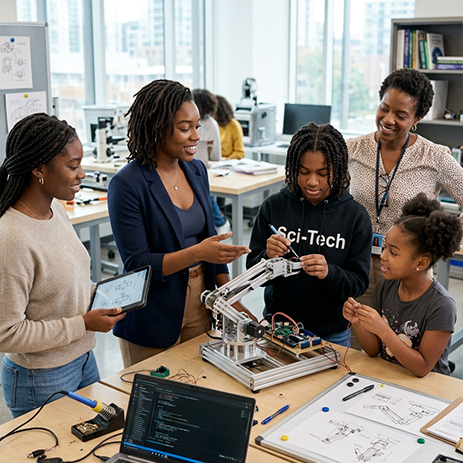
Empowering black women and girls in science, technology, engineering, and mathematics (STEM) to drive innovation and shape Canada’s future.
Challenge Overview
Understanding the STEM Equity Challenge
What the issue is and why it matters
Science, Technology, Engineering, and Mathematics (STEM) are among the most influential fields shaping the future of the global economy. From artificial intelligence and cybersecurity to healthcare innovation, clean technology, engineering, advanced manufacturing, and digital transformation, STEM disciplines are driving solutions to some of the world’s most complex challenges.
Canada’s economic competitiveness depends increasingly on a workforce equipped with STEM knowledge, creativity, and innovation capabilities. However, despite significant progress in promoting diversity in STEM, Black women and girls continue to face persistent barriers that limit their participation, advancement, and leadership within STEM education, careers, entrepreneurship, and innovation ecosystems.
The challenge is not a lack of ability, curiosity, or interest among Black women and girls. The challenge is that many encounter systemic barriers throughout their STEM journey—from early education through professional careers. These barriers include:
- Limited exposure to STEM opportunities at an early age.
- Lack of representation of Black women STEM professionals.
- Stereotypes about who belongs in STEM fields.
- Unequal access to STEM education and resources.
- Limited mentorship and professional networks.
- Barriers entering technology and engineering careers.
- Workplace cultures that may not fully support inclusion and belonging.
- Reduced access to innovation funding and entrepreneurship opportunities.
For many Black girls, the absence of visible role models can influence their confidence, career aspirations, and willingness to pursue STEM pathways. When young people do not see individuals who look like them succeeding in STEM, they may question whether these fields are truly accessible to them.
STEM participation is not only about individual career opportunities—it is about Canada’s future workforce, innovation capacity, and economic resilience.
CBEE Women believes that increasing Black women’s participation in STEM requires a comprehensive approach that begins with early exposure, continues through education and career development, and extends into entrepreneurship, leadership, and innovation.
The challenge is not whether Black women can succeed in STEM. The challenge is ensuring that STEM ecosystems are inclusive enough to recognize, support, and benefit from their talent.
Why It Matters
Evidence, Context, and Implications for Black Women and Canada’s Economy
STEM access, representation, and inclusion shape opportunities for Black women and girls.
The Growing Importance of STEM in Canada’s Economy
STEM skills are increasingly essential across almost every sector of the economy.
Artificial intelligence.
Software Development
Cybersecurity
Healthcare Technology
Engineering
Renewable Energy
Data Science
Fintech
Advanced Manufacturing
Digital Entrepreneurship
As technology transforms workplaces and industries, individuals with STEM knowledge will have greater access to high-growth careers and innovation opportunities.
Ensuring that Black women participate fully in STEM is therefore essential to building a workforce that reflects Canada’s diversity and maximizes its available talent.
The Representation Gap in STEM
Although women have increased their participation in many educational fields, representation remains uneven across STEM disciplines.
Computer science
Engineering
Mathematics-intensive careers
Technology leadership
Research and innovation roles
STEM entrepreneurship
This underrepresentation creates a cycle:
1. Fewer Black women enter STEM fields.
2. Fewer role models become visible.
3. Younger generations have fewer examples of success.
4. Representation gaps continue.
Breaking this cycle requires intentional investment at every stage of the STEM pipeline.
Early Exposure and the Confidence Gap
Interest in STEM often begins during childhood and adolescence.
However, many Black girls experience barriers such as:
Limited access to coding programs.
Fewer STEM enrichment opportunities.
Lack of STEM mentorship.
Limited exposure to STEM careers.
Stereotypes suggesting certain fields are not meant for them.
Early experiences strongly influence whether young people develop confidence in their ability to succeed.
Providing access to STEM education, role models, and hands-on learning experiences can change future career trajectories.
The Importance of Representation and Role Models
Representation matters because it shapes possibilities.
- Engineers
- Scientists
- Software developers
- Data analysts
- Researchers
- Technology entrepreneurs
- Innovation leaders
- Inspiration
- Guidance
- Career insight
- Confidence
- A sense of belonging
STEM diversity is strengthened when young people can envision themselves as future innovators.
Barriers in STEM Workplaces
Even after entering STEM careers, Black women may face additional challenges, including:
Workplace isolation
Lack of mentorship
Limited access to advancement opportunities
Bias in performance evaluations
Underrepresentation in leadership positions
Exclusion from innovation networks
Creating inclusive STEM workplaces requires more than recruiting diverse talent—it requires ensuring that diverse professionals can succeed and advance.
The Economic Impact of Inclusive STEM Participation
Increasing Black women’s participation in STEM contributes to:
A stronger innovation economy
Greater diversity in problem-solving
More inclusive technology development
Increased entrepreneurship
Expanded workforce capacity
Technology solutions are stronger when created by teams that understand diverse experiences and perspectives.
Our Response
Building STEM Pathways for Black Women and Girls
CBEE Women addresses STEM inequities through a full pathway approach:
- Exposure
- Education
- Skills Development
- Mentorship
- Career Access
- Entrepreneurship
- Leadership
Employment support initiatives designed to strengthen participants' ability to successfully navigate the Canadian labour market — helping women understand employment systems while recognizing and valuing their existing skills.
STEM Awareness and Early Learning Programs
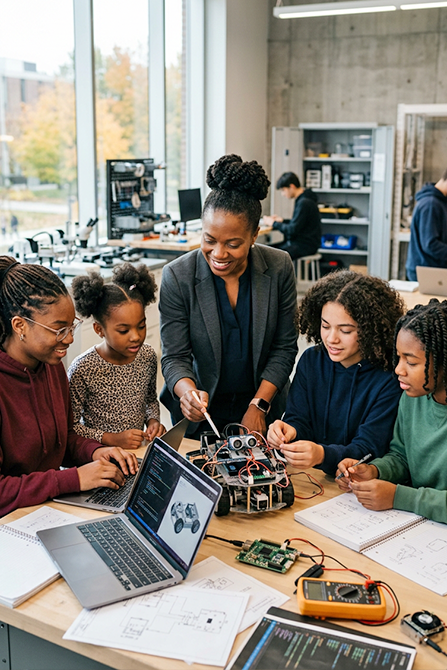
CBEE Women introduces STEM concepts to children and youth through engaging, accessible learning experiences.
- Coding workshops
- Robotics activities
- Science experiments
- Mathematics enrichment
- Engineering challenges
- Technology exploration
- STEM camps
These programs help young learners:
- Build curiosity
- Develop problem-solving skills
- Increase confidence
- Discover STEM career possibilities
Early exposure creates long-term interest and participation
Coding and Digital Skills Development
Technology skills are essential in the modern economy.
CBEE Women supports Black women and girls in developing skills such as:
- Programming
- Web Development
- Data Literacy
- Digital Tools
- AI Awareness
- Cybersecurity Fundamentals
- Technology Entrepreneurship
These skills create pathways into high-demand careers and innovation opportunities.
STEM Mentorship and Role Model Networks
CBEE Women connects participants with STEM professionals, including:
- Scientists
- Engineers
- Technology professionals
- Researchers
- Entrepreneurs
- Academic leaders
Mentorship provides:
- Career guidance
- Technical advice
- Encouragement
- Professional connections
- Increased confidence
Building relationships with successful STEM professionals helps participants navigate educational and career pathways.
STEM Career Development and Workforce Pathways
CBEE Women supports Black women entering and advancing in STEM careers through
- Career exploration
- Industry connections
- Resume development
- Interview preparation
- Professional networking
- Internship preparation
- Workplace readiness
The goal is to bridge the gap between STEM education and employment opportunities.
STEM innovation requires entrepreneurship
CBEE Women supports women creating technology-based solutions through:
- Innovation training
- Business development support
- Technology entrepreneurship education
- Networking Opportunities
- Access to Innovation Ecosystems
Black women must be positioned not only as technology users but as technology creators.
Partnerships with STEM Organizations and Industry
Advancing STEM equity requires collaboration.
- Technology companies
- Universities
- Schools
- Research institutions
- Government innovation programs
- Community organizations
Partnerships create access to:
- Learning opportunities
- Employment pathways
- Research opportunities
- Industry mentorship
- Innovation resources
Research, Advocacy, and Systems Change
CBEE Women promotes long-term STEM inclusion through:
- Research on participation barriers
- Community consultations
- Advocacy for inclusive STEM policies
- Collaboration with education and technology leaders
- Promotion of diversity in innovation ecosystems
The goal is to transform STEM environments so that inclusion becomes embedded in systems, not treated as an exception.
Measuring Impact
Individual, Institutional, and Societal Impact
CBEE Women’s STEM initiatives aim to create measurable outcomes across the STEM ecosystem.
Individual-Level Outcomes
Increased STEM Confidence
Number of participants completing STEM programs.
Improved STEM confidence assessments.
Increased interest in STEM careers.
Increased participation in STEM activities.
Increased STEM Skills
Coding skills developed.
Digital literacy improved.
STEM projects completed.
Certifications or training completed.
Increased Career Opportunities
Increased STEM education enrollment.
Increased internships and employment opportunities.
Increased participation in technology careers.
Education-Level Outcomes
Stronger STEM Pathways for Youth
More Black girls participating in STEM programs.
Increased STEM mentorship access.
Increased STEM career awareness.
Increased Representation in STEM Education
Increased enrollment in STEM courses.
Increased completion of STEM programs.
Increased participation in STEM competitions and initiatives.
Workforce & Industry Outcomes
More Inclusive STEM Workplaces
Increased recruitment of Black women in STEM.
Increased retention of STEM professionals.
Improved workplace inclusion practices.
Increased Innovation
More diverse technology teams.
Increased innovation projects.
More Black women contributing to research and technology development.
Community & Economic Outcomes
Stronger Innovation Ecosystem
Increased Black women STEM entrepreneurs.
Increased technology-based businesses.
Increased participation in emerging industries.
Future STEM Leadership Pipeline
Increased number of Black women entering STEM leadership roles.
Increased visibility of Black women STEM role models.
Stronger intergenerational mentorship networks.
A More Inclusive STEM Future
CBEE Women envisions a future where Black women and girls are fully represented across Canada’s STEM ecosystem. A future where:
Black girls see STEM as a pathway of opportunity.
STEM classrooms reflect Canada’s diversity.
Black women lead technology innovation.
Black women contribute to scientific discovery.
Technology solutions reflect diverse communities.
Canada benefits from the full creativity and talent of its people.
Join the Movement
Building an Inclusive STEM Future
Creating STEM equity requires collective action.
Governments
Funding STEM education programs.
Supporting underrepresented communities.
Investing in digital skills development.
Creating inclusive innovation policies.
Supporting Black women in technology entrepreneurship.
Technology Companies & Employers
Building inclusive recruitment pipelines.
Supporting STEM mentorship.
Investing in diverse talent development.
Creating equitable advancement opportunities.
Partnering with community organizations.
Schools & Educational Institutions
Provide early STEM exposure.
Create inclusive STEM classrooms.
Connect students with role models.
Support girls pursuing STEM pathways.
Research & Innovation Institutions
ncrease diversity in research teams.
Support inclusive innovation.
Create opportunities for emerging STEM leaders.
Community Organizations
Deliver culturally relevant STEM programs.
Support families and youth.
Build partnerships.
Increase access to STEM opportunities.
Individuals
Encouraging girls to explore STEM.
Mentoring young learners.
Supporting diverse innovators.
Challenging stereotypes about who belongs in STEM.
Empowering the Next STEM Leaders
CBEE Women believes STEM is not only about technology—it is about opportunity, creativity, leadership, and shaping the future. By empowering Black women and girls in STEM, Canada strengthens its innovation capacity, expands economic opportunity, and builds a future where every talented individual can contribute. When Black women innovate, Canada advances. When Black girls are empowered in STEM, the future becomes limitless.